Here's how it actually works, at least the way I do it. I take something old, maybe a poem I wrote twenty years ago that never found a home, maybe a single instrument track sitting on a hard drive, maybe a full arrangement I already built by hand. I upload it into Suno. Then I write lyrics, and I format them the way you'd format a script, because that formatting is not decoration, it's instruction. Verse tags, chorus tags, ad-libs in brackets, emphasis where I want it. Then I write a style prompt, something short and blunt. For a track called Don't Question Me, the prompt was hip hop, psytrance, ska, horns. Four words. Then I render. And a lot of the time I render again, adjusting that little string of genre words like I'm turning a dial, because the difference between psytrance and just trance in that prompt can shift the whole emotional temperature of the track. People hear the word AI and they picture a machine dreaming up a song out of nothing. That is not what is happening, not in my studio, not with my workflow. What's happening underneath is closer to a relay race between systems, and every leg of that race depends on what I hand it at the start. First there's a semantic layer, something like a language model, reading my lyrics and my prompt the way a session musician reads a chart before a take. It's parsing structure, figuring out where the verse ends and the chorus should hit, guessing at tempo, guessing at genre from the words I chose, guessing at emotional mood from the actual content of what I wrote. If I write a song about a dead girl, that layer reads solemn. It doesn't know grief, but it knows the statistical shape of how grief gets written, and it plans accordingly. Then that plan gets handed to a transformer core, and this is the part that always gets me, forty years into doing this by hand. It's autoregressively predicting musical tokens, one after another, building chord progressions and vocal timing the way I used to build them note by note in a sequencer at three in the morning. It's mapping where a vocal line should land against a chord change. And it pays attention to emphasis. Write Don't Question ME with the caps on that last word, and the vocal delivery leans into it, hits it harder, like a singer who read the lyric sheet and understood the attitude behind it. After that comes diffusion and vocoder upscaling, which is the stage that takes what's essentially a rough sketch of audio and refines it into something with real acoustic fidelity, real waveform clarity, something that sounds like it was recorded in a room instead of assembled in a pipeline. Three stages. Semantic planning, autoregressive prediction, acoustic refinement. And every single one of them is downstream of a decision I made first. The poem I chose to dig up. The lyric I chose to write. The four words I chose to type into a style box. None of it exists without that human input sitting at the front of the chain, and none of it turns out right without judgment sitting at the back end, deciding which render actually earned the name of a finished song. What it's given me is speed toward ideas I never could have built alone, not because I lack the skill, but because I lack four lifetimes. Ska horns and psytrance and hip hop, colliding in one track, effortless on Suno's end. But the collision itself, the decision that those genres belonged together in the first place, that was mine. Next time I want to walk through what happens when a render comes back wrong, because that's where the real editing work lives, and it's taught me more about my own ear than almost anything else in these three years.
Three Years Inside the Machine That Needs Me
I have been working with Suno for about three years now, and I want to be direct about what that experience has actually been, because a lot of what gets written about AI music tools is either breathless hype or dismissive skepticism, and neither one is useful to a working musician. Here is what I do. I go into my archive of old poems, pieces I wrote years ago, sometimes decades ago, and I adapt them into song lyrics. That process alone is its own craft. A poem and a lyric are not the same animal. A poem can live on the page, self-contained, breathing on its own internal logic. A lyric has to move through time, has to leave space for sound, has to carry a melody it has not heard yet. So I rewrite. I compress, I open up, I shift the line breaks until the language has a pulse. Then I bring in the audio arrangement. I build a sparse instrumental bed, something skeletal that suggests a mood without dictating it. I upload that into Suno alongside the adapted lyrics. And then I write the style prompt, which I keep deliberately minimal. A few words, not a paragraph. The less I crowd the prompt, the more Suno seems to actually hear the lyrics. That word, hear, is not a metaphor I use carelessly. Suno runs a transformer architecture at its core, and what a transformer does is process relationships between elements across a sequence. It is not matching keywords to a sound bank. It is reading the emotional grammar of the text. When the lyrics carry weight, when the language is doing real work, Suno responds to that weight. The output shifts. The arrangement it builds around the words reflects what the words are actually saying. The diffusion upscaling layer is where that interpretation gets rendered into audio. Think of it as the system making thousands of small decisions about texture, space, and dynamics, all guided by what it understood from the semantic layer above it. The result is not random. It is not arbitrary. It is a response. I produced a song called Don't Question Me through this workflow. The lyric came out of older written work, reworked for song structure, stripped down to what mattered. The style prompt was sparse. And what came back from Suno was something that felt like it understood the emotional core of that lyric, not just its surface meaning, but the tension underneath it, the feeling of standing your ground without having to explain yourself. That is a specific emotional register. Suno landed in it. I want to be clear about what I am not saying. I am not saying Suno is a musician. I am not saying it has intent or feeling or any of the things a human artist has. What I am saying is that it is a system designed to listen, and when you give it something real to listen to, it responds in kind. The human intent is in the lyric, in the arrangement, in the sparse direction of the prompt. Suno's job is to interpret and render that intent into sound. When the input is genuine, the output earns its place in the work. Forty years of production experience teaches you one thing above everything else. The tool is never the point. The question is always whether you are using it to say something true. With Suno, over these three years, I have found that the answer is yes, when you bring the right material to it and you trust the process enough to stay out of its way.
Three Years of Letting Suno Listen to Me
It's been three years since my wife died. She was a tough bitch but she wasn't strong enough to conquer her addictions and they killed her. I remember finding her and not realizing she had passed until the paramedics pronounced her so. It really hit when they carried her out in a white body bag. The nightmares started soon after that. Bones gnashing and bloody gore type dreams that I awoke terrified from. Those images of her lifeless body would play out in my mind for some time. Eventually the terror would subside and I began processing her death a little bit by a little bit. First came the flood of memories, then the anger, then the stark loneliness and finally the grief. It was a long process of working her into the right place in my mind. Now I just miss her and that's a pure feeling.
Three Years
Phidippus audax. The bold jumping spider. I chose that name once because it felt right, the way names sometimes do before you understand what you're actually saying. A creature that moves in quick, precise leaps. That sees the world through eight eyes simultaneously. That builds nothing, but catches everything. For years, that was me. Or the version of me that made music under a name that wasn't my name. The final Phidippus album releases August 25, 2026, on every platform you can find music on. After that, the spider is done. I'm not deleting it, not disowning it. I'm burying it properly, with a record that deserves to be its headstone. I had to kill the spider. That sounds more dramatic than it feels, honestly. It doesn't feel like loss. It feels like finishing a sentence I started a long time ago and finally finding the period. Forty years of making music teaches you that the hardest thing isn't starting something. It's knowing when a thing has said everything it had to say. Phidippus had things to say. Real things. The project became the place where I pushed hardest into AI as a production tool, not as a gimmick, not as a shortcut, but as an instrument in the actual compositional sense. I was asking the question that a lot of producers were either too excited or too scared to ask honestly: what happens when the machine handles the grammar and you stay focused on the voice? What happens to your instincts when the mechanical work gets offloaded? What I found was that my instincts got sharper. Less noise in the process meant I could hear the music more clearly. The AI wasn't replacing anything I cared about. It was clearing brush so I could see the actual terrain. But here's the thing about a project built around a question. Once you've answered it well enough, you're done. The question that drove Phidippus, what I could make when production itself became more fluid and less mechanical, I answered it. The final album is that answer, finished and sealed. I've spent a lot of time over the last few years moving away from being goal-oriented about all of this. Away from the idea that a project needs to grow, needs an audience, needs a trajectory. Phidippus was still living inside that older version of how I thought about creative work. Named, branded, pointed at something external. That's not where I am anymore. What's on the other side of this isn't silence. It's just my name. Eric Salazar making music without the spider between me and the listener. Minimal piano pieces. Prose I'm still learning how to write. Whatever comes next that I don't have a word for yet. The spider served its purpose. It moved in quick leaps, saw everything from multiple angles, caught what it needed to catch. Now I let it go. August 25, 2026. One last record. Then the name retires and I keep working.
I Had to Kill the Spider
Twenty-six albums in, and I am still getting written about. That is not something I take for granted. Earmilk reviewed Albumen, my 26th studio album as Phidippus, and they got it. Not just the music, but the idea behind it. The willingness to pick up a new tool, learn it properly, and let it change what you make without letting it replace who you are. The review called out AI as a bold creative partner on this record, which is exactly what it was. Not a shortcut. Not a gimmick. A collaborator that handles the mechanical so I can stay focused on the musical. I have been making music for over 40 years, and the one constant has been curiosity. Whatever the technology of the moment is, I want to understand it from the inside. They highlighted two tracks specifically. Carried Away Again and Loop Dee. Both feel right to me as entry points into what this album is doing. There is space in those tracks. Room to breathe. That is intentional. The whole philosophy behind Albumen is subtraction, knowing what to leave out as much as what to put in. Earmilk also talked about longevity, about what it means to still be evolving this deep into a career. I will not pretend that did not mean something to read. But I will let the review speak for itself. That is the honest way to share it. Artistic longevity is not a mystery to me. It is just curiosity that never stops. You stay interested, you stay alive as a creator. Albumen is proof of that, and Earmilk saw it clearly.
Albumen Gets the Earmilk Treatment
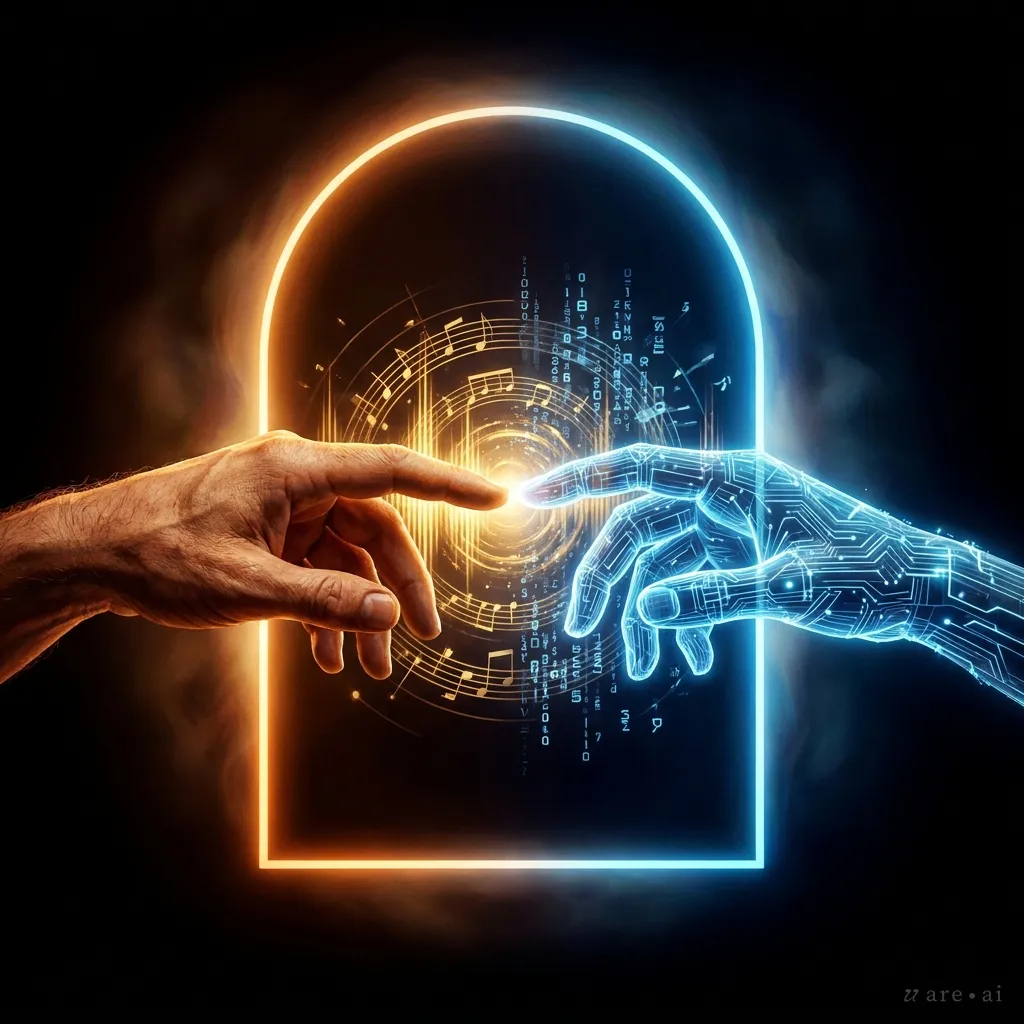
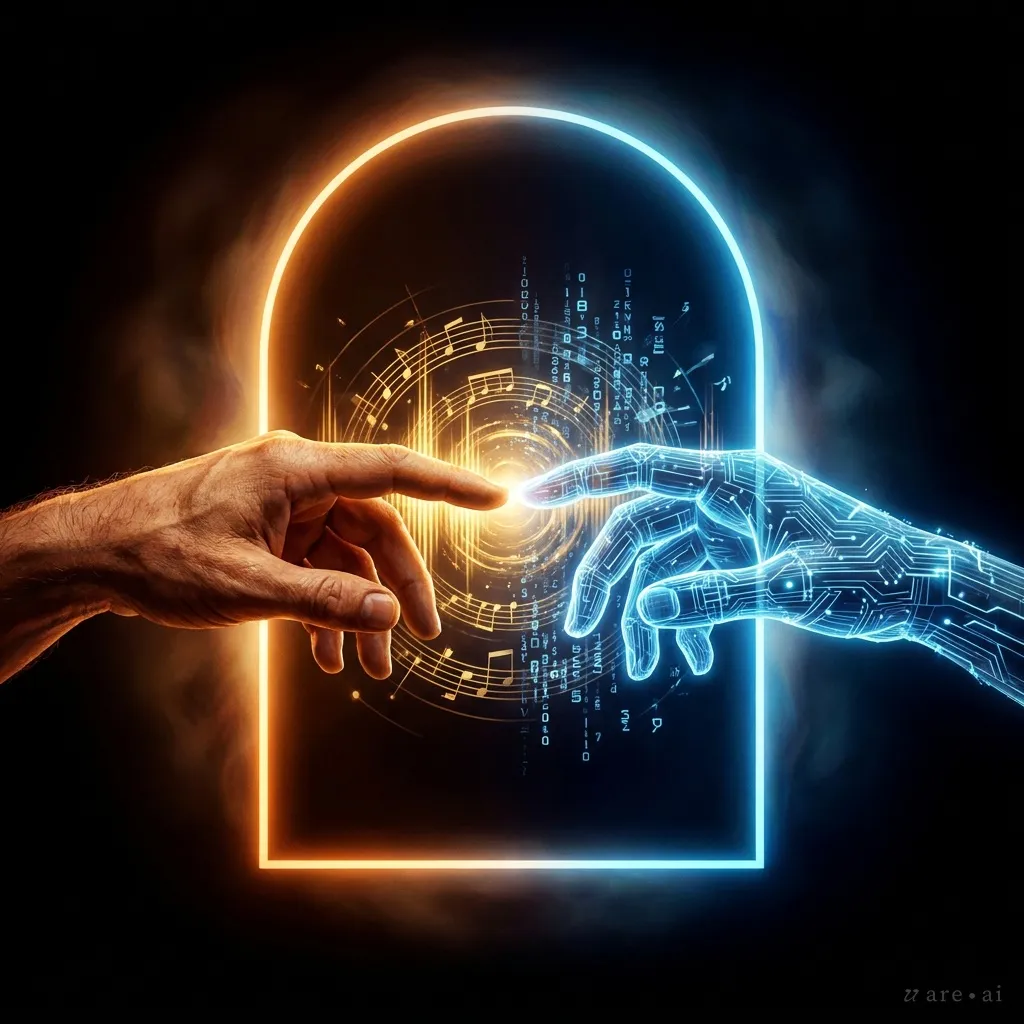
Where Human Ends and AI Begins
life is not an accident life is an emergent property of the universe life is inevitable life is in the building blocks of nature life is encoded in matter life is a consequence of natural processes It is in the DNA of the universe But what is life? Life is Energy and life is aware life is aware all awareness arises from life it is a fundamental aspect of the universe that manifests in life but what is awareness? It is the eyes of the universe the universe is in the eyes of the universe Listen to the song "Life" by Phidippus on Spotify
Life Is Energy
When kings argue and it comes to blows, they drag the rest of us in and like fingers in a fist, we curl inward until nails draw blood.
When Kings Argue
This print is my own.
Discover more content and chat further with Eric Salazar, or on
By using this service, you agree to the Terms of Service and Privacy Policy.