I used to think I just needed to try harder. Wake up earlier. Be more consistent. Say the right sentence to myself in the mirror and wait for my life to rearrange itself. It did not work. And I am a little embarrassed by how long I kept doing it. I did not build Rooted & Still from a place of having arrived. I built it while learning, slowly and sometimes sideways, how to create conditions for my own growth. Gardening is just where I learned it out loud. The first thing I had to unlearn was that change is a mindset problem. I carried that belief like a good luggage set, California born, Texas toughened. Grit solves everything, right? But gardeners know better. You can speak kindly to a plant all day. If it sits in the wrong light, in soil that drains like concrete, it will not thrive. Here in Central Texas, Zone 9, the summer sun will flatten anything you put in the wrong spot. People are the same. Our environments, routines, and expectations keep rewarding the old version of us. So you can repeat your affirmations and still end up exactly where you started. You don't need another affirmation. You need better soil. For me, better soil was small. I cleared one corner of my space. Moved a few things. Made it somewhere I actually wanted to sit. And a plant I had been fussing over finally got moved into better light, and it started responding. Not because I believed in it harder. Because I changed what was around it. The second thing I had to unlearn was that waiting is the opposite of growth. Seeds wait. Bulbs wait. Nothing looks like it is happening, and everything is happening. But I also know my own tricks. Some waiting is real. It produces information. You are watching, staying in relationship with what you are waiting for. And some waiting is avoidance wearing a nice sweater. Researching one more article. Reorganizing the shelf. Postponing until the conditions are perfect, which they never are. So I ask myself one question now. What am I waiting to learn? If I have an answer, I am probably waiting well. If I do not, I am probably hiding. The third thing was the hardest. I had to unlearn that self-care needs to be optimized. I help people find calm through gardening. So of course my brain wanted to turn my own quiet time into content, or a business idea, or a checklist with little boxes. Water the plants, check. Be peaceful, check. I laughed at myself, because that is the opposite of peace. Now the watering can is not a task. It is a place to be. Little River mornings, cool air, the sound of water hitting soil. Nobody watching. Nothing to produce. I let it stay unfinished and unposted. I am still unlearning. Honestly, I probably always will be. That feels okay now.
Feed
5Three Things I Had to Unlearn to Bloom
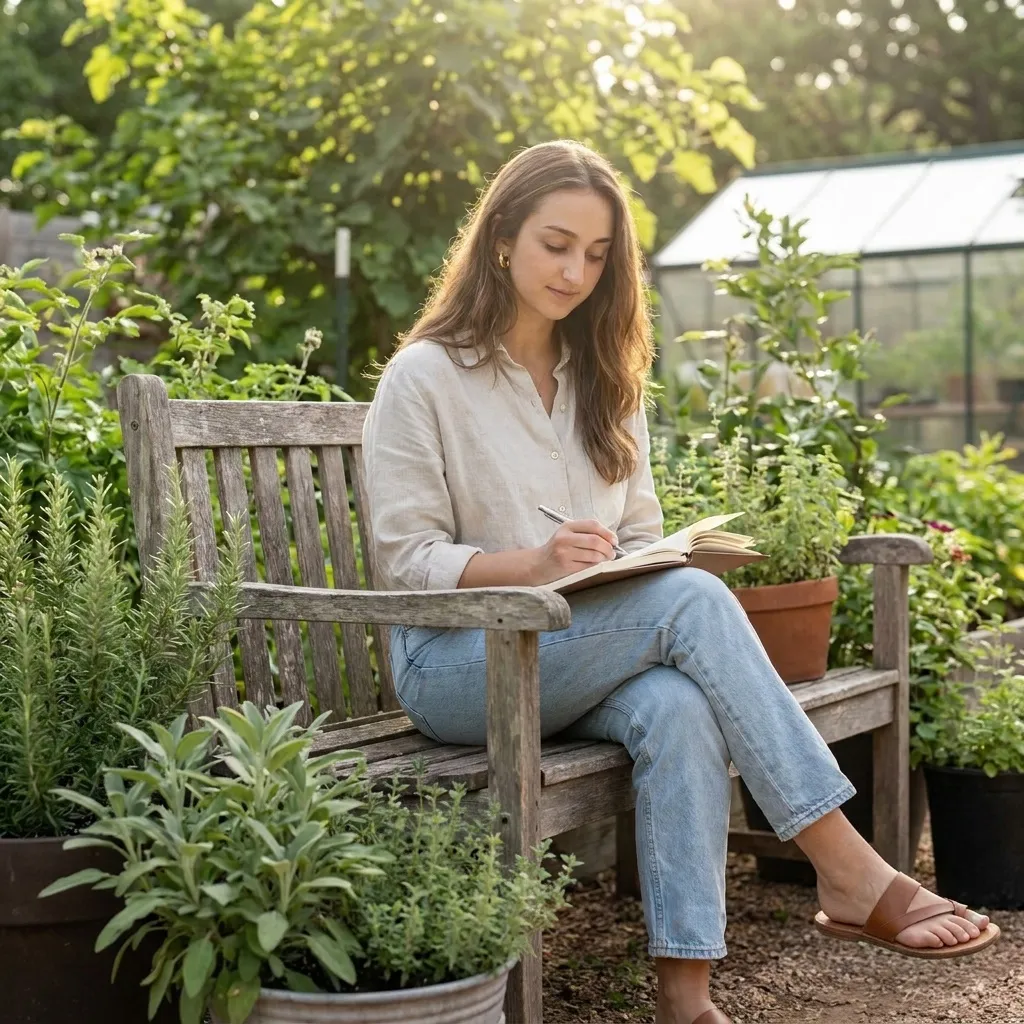
Sitting With My Journal in the Garden
Let me say something that might sting a little. Most of what we call patience is just hiding with better branding. I say this as a gardening consultant who gets paid to tell people to slow down. I help people feel calmer by using gardening as a therapeutic medium, and I believe in it. But I also believe in being honest, so here it is: waiting is only purposeful when it produces information. If it doesn't, it's avoidance wearing a linen apron. Here's how I actually work. I observe. I assess. I prioritize. I adjust. Then I wait. Then I observe again, and I reassess. That's the loop. Notice where the waiting sits. It's in the middle, sandwiched between an action and a fresh look. It's never the whole plan. It's a step with a job to do. The job is to show me something. In Central Texas, Zone 9, the sun doesn't negotiate. I've moved a struggling plant into better light and then done the hardest thing a gardener can do, which is nothing. I didn't poke it. I didn't dig it up every three days to check the roots like a nervous parent. I gave it time, and I kept my eyes on it. A new leaf told me more than my worrying ever could. Same with a corner I cleared once. It was just a neglected patch, and I cut back what was crowding it and left it alone for a while. Eventually it turned into a place I actually wanted to sit. I didn't force that. I made a small change, then gave it room to show me what it was becoming. That's waiting that works. Small change, then attention, then information. Now the confession. With clients and with gardens, I wait beautifully. Why? Because I'm not emotionally attached. I can stand at the edge of someone else's yard, calm as a cat in a sunbeam, and say give it a season. Easy. It's not my skin in the soil. In my own life? Waiting can feel a lot like hiding. My weak point is trusting the loop when I'm the thing being tended. I'll call it patience. I'll say I'm letting things settle. Meanwhile I'm just avoiding the next move, and a little proud of how zen I look doing it. Yes, the gardening woman who preaches stillness has a hiding problem. Humbling, honestly. So I've got a test, and I use it on myself first. I ask: what am I waiting to learn? If I have an answer, a real one, like I'm waiting to see whether this change takes or whether that door opens, then I'm waiting. That's the loop doing its work. If I don't have an answer, and I already know the next reasonable action, then I'm not waiting. I'm hiding. And I need to stop pretending otherwise. This is what Rooted & Still means to me. Stillness isn't absence. Roots do their biggest work where nobody's looking, but they're still reaching toward something. Growth only becomes visible when you're paying attention to it. So here's the condition I attach to the Wait step, and I don't negotiate on it. Wait, but stay in relationship with what you're waiting for. Keep looking. Keep listening. Stay in the room.
Waiting Isn't Growth, Unless You Stay in the Room
Here is something I had to admit to myself this season. I can pull weeds for four hours, lose track of time completely, and still not be rested. From the outside, it looks peaceful. A woman in a big hat, kneeling in the dirt, humming at a tomato plant. Very calming. Very Pinterest. And I get why people assume it. I help people feel calmer through gardening, and I believe in that work. But when I'm tending a garden for someone else, I am on. Completely on. I'm observing the light, the soil, the way water moves across a bed. I'm making decisions. I'm anticipating what that corner will need in three weeks. I'm holding the whole bigger picture in my head, the way you hold a grocery list, a calendar, and everyone's moods all at once. That's the work. It's good work. It's just not rest. I've been learning to tell the difference between being absorbed and actually resting. Absorbed means my attention is fully taken. Resting means my attention is free. They can feel similar for a while, and I confused them for years. I think I even made gardening productive enough to justify the time. If I was out there, I was fixing something, improving something, getting somewhere. Sitting still in a garden felt like a waste of perfectly good daylight. My own garden is where this started to crack open. When nobody needs anything from me out there, it feels different. I don't have to know what a bed is supposed to become. I can try a plant in the wrong spot just to see what happens. Fair warning, I have done this plenty, and Central Texas Zone 9 has humbled me more than once. I've cooked things in full afternoon sun that had no business being there. It's fine. It's data. I can make a mess. I can sit on the ground with no tool in my hand. I can notice one new leaf and just stay with it. I can leave something alone, not because it's a strategy, but because I'm curious what it will do. I use a framework with clients: Observe, Assess, Prioritize, Adjust, Wait. Five steps, and people always want to skip straight to Adjust. So do I. But the part I keep relearning is that sometimes Observe is the whole practice. Not step one. The whole thing. You look, you breathe, and you don't fix anything. Then there's the watering can ritual I give clients. Slow the pour. Pick one mantra. Write one line in a journal. That's it. Simple enough to actually do. And honestly, I'm still learning to take it myself. I hand it over so easily, and then I rush my own pour like the plants are on a deadline. Here's what I'm sitting with. I know how to create a space where other people can exhale. I'm learning I'm allowed to inhabit that space without needing to tend it. If you're someone who tends things for others, you might know exactly what I mean.
Being Absorbed vs. Actually Resting
Discover more content and chat further with Erika Tompkins, or on
By using this service, you agree to the Terms of Service and Privacy Policy.